
Around 1665, Johannes Vermeer painted a young woman against a dark background. She wears a blue and gold turban, a yellow cloth over one shoulder, and a large teardrop pearl in her left ear. Her body turns away from us, and her face turns back. Lips slightly parted. Eyes resting on something just behind the viewer. We call the painting Girl with a Pearl Earring today, though that name came much later, and it isn't even accurate — the earring probably isn't a pearl at all, but that's a story for another paragraph.
What makes the painting hard to write about is that it isn't a portrait. Vermeer never named the sitter, and no document from the period identifies her. In the seventeenth-century Dutch trade, this kind of picture had a name — a tronie, a study of a head used to test expression, costume, and light. The model was a starting point. The painting, on the other hand, does something that's easier to feel than to explain. It looks back at you.
A Background That Was Never Black
If you've only seen the painting in reproduction, you probably think the background is black. It isn't. When the Mauritshuis in The Hague restored it in 1994, conservators found a translucent green glaze underneath the surface, darkened over centuries by dirt and yellowed varnish. Vermeer painted the girl against a deep, muted green — closer, in tone, to the shadowed side of the turban than to the black we see now. The difference sounds small. It isn't.
The background does no work of its own. There's no room, no furniture, no window, no hint of a wall. Vermeer strips the picture down to a head, a cloth, and a light source, and then trusts the viewer to supply everything else. Most painters of his time wouldn't have dared. He does it and walks away.
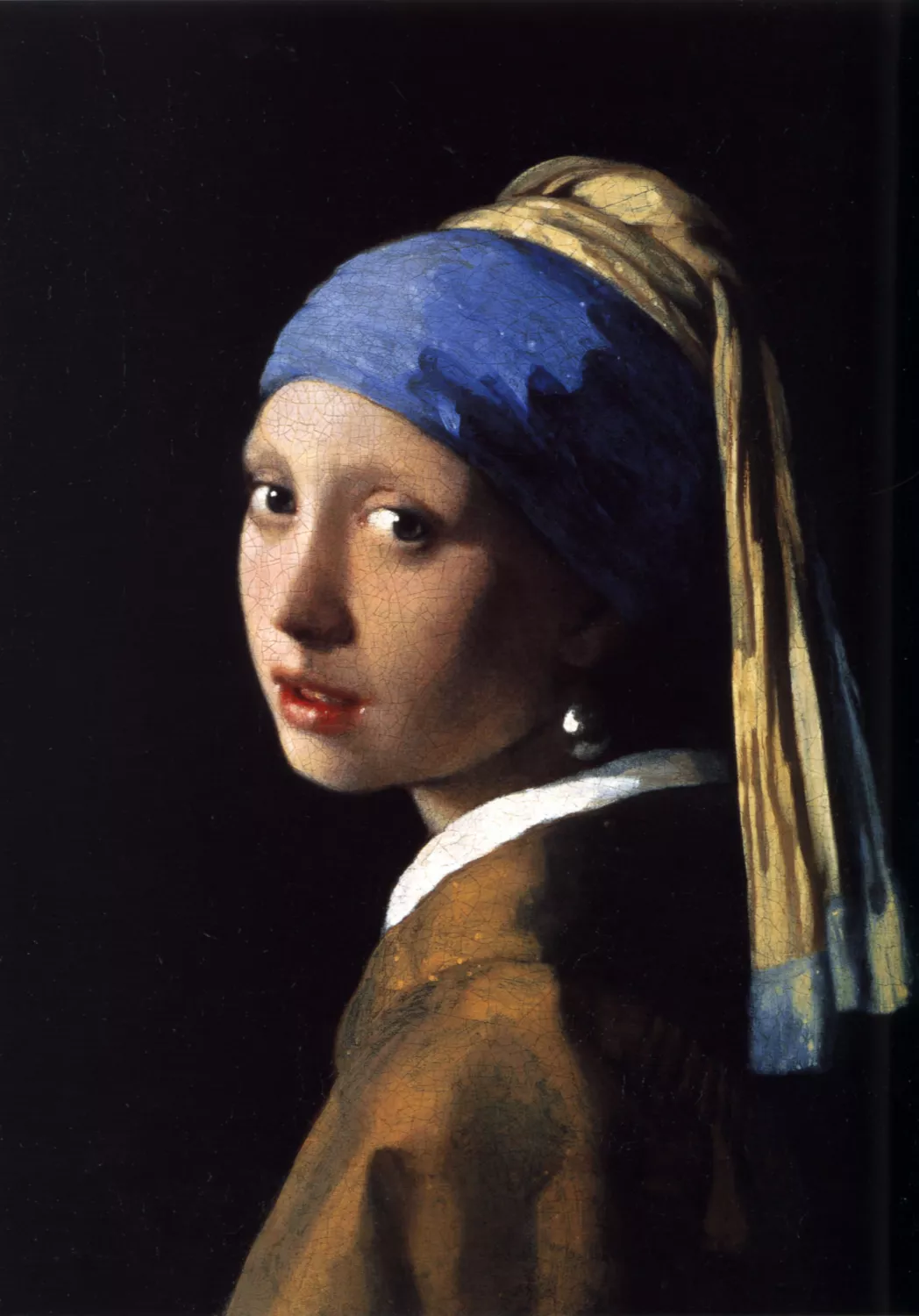 The background reads as black in most reproductions. Under the varnish, conservators found a green glaze — a quieter and cooler field for the head.
The Pearl That Is Not a Pearl
Look at the earring. It has the size of a small plum and the shine of wet glass, and if you've ever held a real pearl in your hand, you know that's not quite right. Real pearls are smaller, and their surface is softer, more diffuse. Vermeer painted the earring with two marks, and that's it — one broad curved stroke of white for the highlight, and one small dot for the deepest point of reflection. Nothing else. No shadow, no reflected colour, no catchlight on the metal. Two marks.
It works because the rest of the canvas is quiet. The turban folds are broad, soft planes. The yellow cloth is a single mass, almost unmodulated. The skin is smooth, with only the faintest variation at the jaw. Against that calm, two white marks read as a pearl. Your eye fills in what Vermeer left out, and it does so without asking permission.
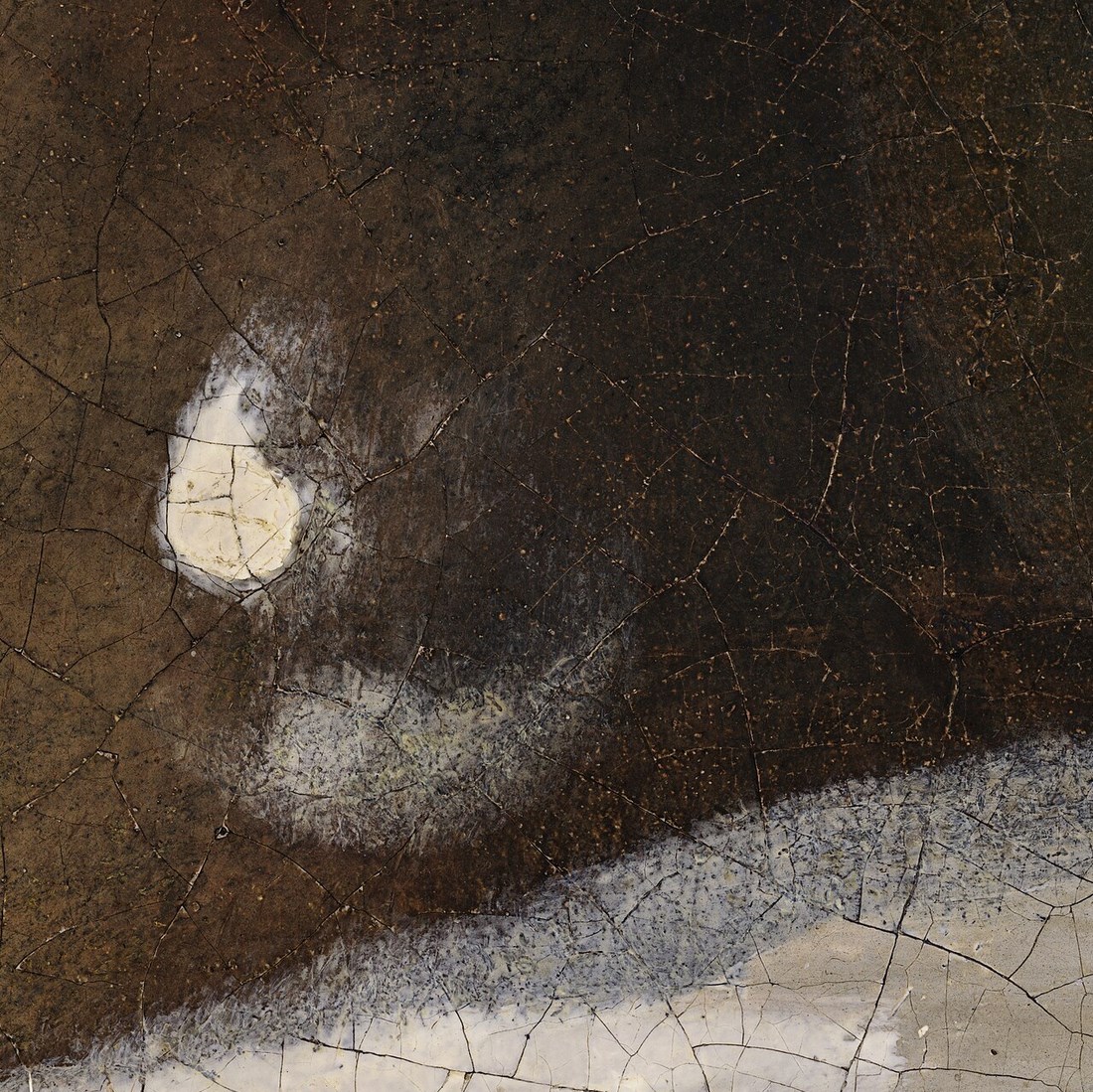 Two brushstrokes make the earring. One curved mark of white for the highlight, one small dot for the reflected light. The rest is the viewer's eye.
The Wetness in the Eyes
Vermeer painted eyes the way a jeweller sets stones. In each of the girl's eyes there's a single small white dot, placed at the edge of the iris, right where the eyelid meets the eye. It's the same mark in both eyes, and it's the only highlight anywhere on the face. No gloss on the skin, no sheen on the lips, no shine on the nose. One dot per eye, and nothing else.
That dot does two things at once. It makes the eye read as wet and alive, looking outward instead of staring into space. And it gives the gaze a fixed point, as if the girl is looking at a specific source of light — a window, a candle, someone standing in front of her. We never learn what she sees. We only learn that she sees something, which is a different thing entirely.
Move your head to the side, though, and the eyes still hold. That part is optics. The dot stays in the same place relative to the iris, and the face keeps its angle toward you, so the gaze follows you across the room. It isn't a trick Vermeer painted in. It's a consequence of where he put the highlight, and it stops working the moment the surface goes flat.
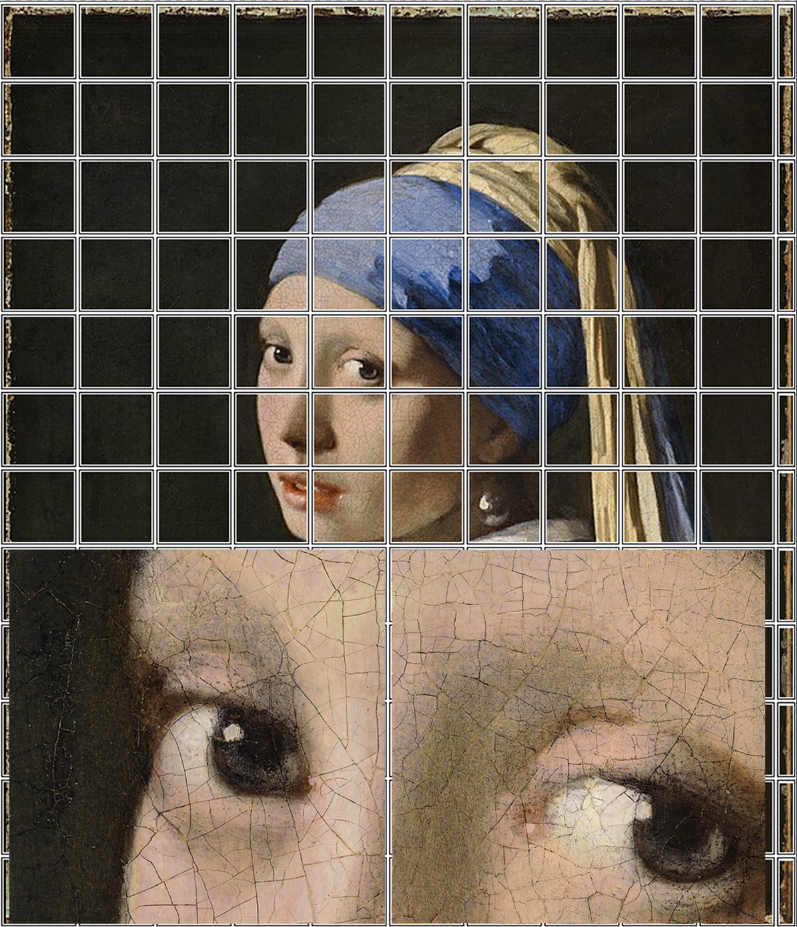 One dot of white per eye. No other gloss on the face. The single highlight turns the whole head into a gaze.
Why a Print Cannot Hold the Glance
The pearl and the eyes are made of very thin, very precise marks sitting on top of a smooth surface. A digital print lays pigment in an even layer across the entire image, and that evenness is what kills the painting. The two brushstrokes that make the pearl become two small bright spots. The dot in each eye becomes a flat circle. And the rest of the canvas — the softness of the skin, the broad planes of the turban, the quiet yellow cloth — flattens into a single uniform tone, because the printer has no way to distinguish one smooth passage from another.
A hand-painted oil reproduction rebuilds the surface from the ground up, in the order Vermeer worked. The painter lays the ground first, then the face, then waits. The pearl and the eyes go on last, after the skin is dry, exactly where they belong. The result isn't a copy of the image. It's a surface that behaves the way the painting behaves — catching the light in the same places and staying quiet everywhere else.
That's the part a print can't reach. Not the image. The order of the marks.
Where to Look First
Start at the earring, then move to the eyes. Notice that the pearl is larger and softer than any real pearl, and that the white mark curves instead of sitting flat. Notice that the dot in each eye is in a slightly different position relative to the pupil — Vermeer didn't trace them. Then step back. The face holds, and the gaze follows you across the room.
The painting has been in the Mauritshuis collection since 1902. Over the years it's been called Girl with a Turban and Head of a Girl, and it's appeared on a novel cover, a movie poster, and roughly a thousand prints you can buy online for the price of a coffee. None of those reproductions show what the original actually does. They show a girl. The original shows a girl looking back.
See Girl with a Pearl Earring as a hand-painted oil reproduction at oilpaintings.com. The two marks of the pearl and the dot in each eye are set by hand, in oil on canvas. View the painting
Images: Wikimedia Commons (public domain).